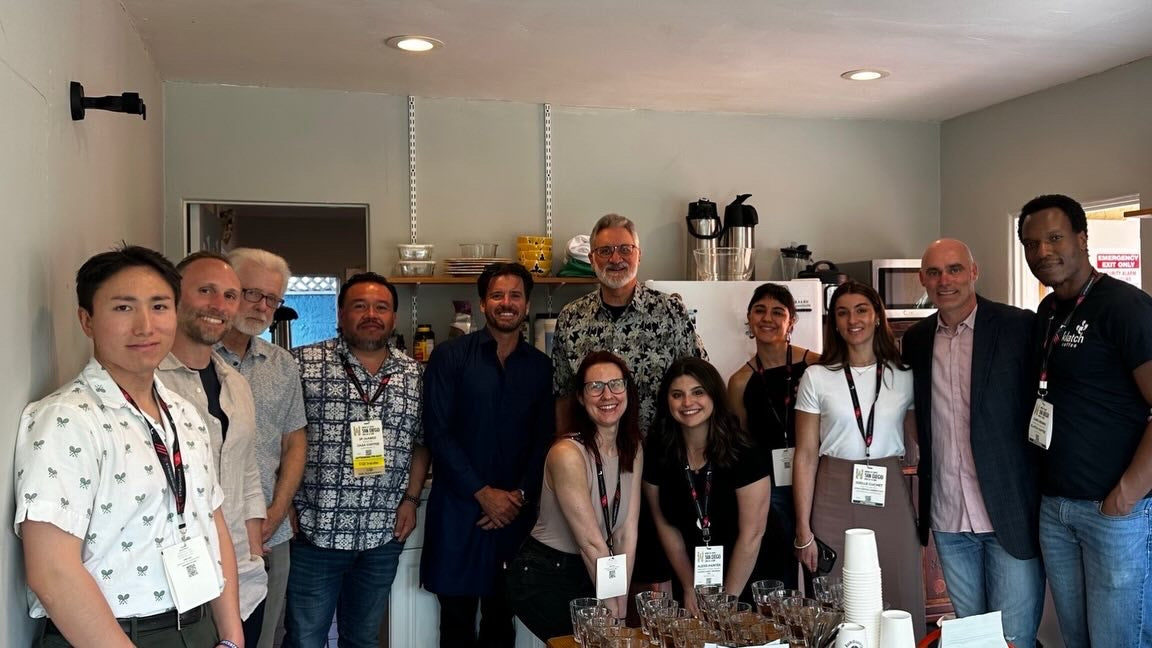
During a week when the global coffee industry gathered in Southern California for Specialty Coffee Association’s World of Coffee San Diego, a different kind of coffee conversation quietly took shape. While much of the attention at major trade events often centers on familiar origins, processing trends, equipment launches, and market dynamics, one session invited attendees to explore something still largely unknown to many professionals: Excelsa coffee.
In partnership with <a href="https://www.ncausa.org/" target="_blank" rel="noopener noreferrer">National Coffee Association USA</a> Next Gen and <a href="https://www.sintercafe.com/" target="_blank" rel="noopener noreferrer">Sintercafé</a> Next Gen, Excelsa Coffee Company hosted what was described as the first Excelsa-exclusive cupping in the United States. The event brought together emerging professionals for an afternoon focused on tasting, discussion, and connection, all centered around one of coffee’s most underexplored categories.
For an industry built on curiosity, quality, and continuous learning, it was exactly the kind of moment that helps shape the future.
A Coffee Many Have Heard Of, But Few Have Truly Explored
Excelsa occupies a unique place in coffee. It is often discussed as a distinct species and is sometimes classified within the Liberica family. What is certain is that it remains a tiny fraction of global coffee production and is still unfamiliar to many roasters, buyers, baristas, importers, and even longtime coffee professionals.
That rarity has created intrigue, but also misunderstanding.
Many in the industry know Arabica and Robusta well. Those two categories dominate global production and most commercial conversations. Excelsa, by contrast, has often existed at the margins, mentioned occasionally but rarely featured in a dedicated educational format.
That is what made this event significant.
Rather than treating Excelsa as a novelty or side note, the session placed it at the center of attention. Participants were invited to evaluate it seriously, compare examples from different origins, and discuss where it might fit in the broader coffee ecosystem.
For many in attendance, it was their first meaningful experience with the coffee.
A Guided Tasting Designed for Real Learning
The event was structured as both a cupping session and a networking experience. That combination proved effective.
Attendees had the chance to taste Excelsa coffees from two separate origins, allowing them to compare how terroir, processing, and production choices can shape the final cup. Instead of a single sample presented as representative of the category, guests experienced range and variation.
That matters because no coffee type can be understood through one example alone.
The guided format also created room for open dialogue. Participants could ask questions, compare notes, challenge assumptions, and share sensory impressions in real time. This type of collaborative tasting environment is especially valuable when introducing a coffee many people have never studied closely.
There was also enough room for connection beyond the cup.
Emerging professionals from different corners of the industry were able to meet, build relationships, and exchange perspectives. In an industry where future leadership often forms through shared experiences like these, the networking component added real value.
Challenging Assumptions in the Cup
One of the most common responses from attendees was surprise at how approachable the coffees were.
Excelsa is sometimes described in abstract or outdated terms, which can create misconceptions before anyone tastes it. But in the session, participants encountered coffees that were bright, fruity, layered, and complex.
Those characteristics challenged simplistic comparisons often made between Arabica and Robusta.
Rather than fitting neatly into preexisting categories, the coffees demonstrated their own identity. Some tasters noted fruit-forward qualities. Others focused on complexity, balance, and structure. For many, the experience broadened their sense of what Excelsa can be when carefully sourced and thoughtfully prepared.
This is one of the most important functions of cupping culture in coffee. It replaces hearsay with firsthand experience.
When professionals taste for themselves, categories become clearer, opportunities become more tangible, and innovation becomes easier to imagine.
Why This Moment Matters
At first glance, a two-hour tasting event may seem small compared with the scale of global coffee markets. But meaningful industry change often begins in rooms exactly like this.
New ideas usually enter coffee culture through a sequence of stages:
- Curiosity
- Exposure
- Credibility
- Trial
- Adoption
This event advanced Excelsa through several of those stages at once.
By partnering with respected organizations such as the <a href="https://www.ncausa.org/" target="_blank" rel="noopener noreferrer">National Coffee Association USA</a> and <a href="https://www.sintercafe.com/" target="_blank" rel="noopener noreferrer">Sintercafé</a>, the tasting created credibility. By inviting emerging professionals, it created exposure among the next generation of buyers, operators, and decision-makers. By presenting multiple coffees in a professional setting, it encouraged trial grounded in sensory evaluation rather than marketing claims.
That combination is powerful.
The future of coffee will not be shaped only by the biggest brands or largest producing countries. It will also be shaped by new categories, resilient species, and professionals willing to rethink what belongs on the table.
Excelsa and the Search for Resilience
Excelsa’s growing relevance is tied not only to flavor but also to agriculture.
As climate pressures intensify across many producing regions, the coffee industry is increasingly interested in diversification and resilience. Producers, traders, roasters, and researchers are all asking versions of the same question: what can help secure the future of coffee supply?
While Arabica remains foundational, it faces well-documented challenges related to disease pressure, changing weather patterns, temperature sensitivity, and economic volatility.
That has increased interest in alternative species and underutilized genetic resources.
Excelsa is part of that conversation.
Its agronomic potential, adaptability in certain climates, and differentiated cup profile make it worth deeper exploration. No single species will solve the industry’s structural challenges, but expanding the portfolio of viable coffees can strengthen long-term resilience.
Events like this help connect that agricultural conversation to the commercial side of the industry.
When professionals taste quality examples and understand market potential, pathways for future demand begin to emerge.
Building the Bridge Between Origin and Market
One of the recurring challenges for emerging coffee categories is the gap between production potential and market understanding.
Farmers may be able to grow something promising. But without buyers, education, and consumer pull, opportunity remains theoretical.
That is why visibility matters.
By showcasing Excelsa at a major international gathering in San Diego, the event helped place the coffee in front of roasters, traders, educators, and entrepreneurs who influence purchasing decisions and shape trends.
It also demonstrated that Excelsa belongs in serious professional conversations, not only in niche side discussions.
For producers around the world exploring Excelsa cultivation, that kind of market signal can become meaningful over time.
Gratitude to the Team Behind the Event
Successful industry gatherings rely on people who do the often invisible work of coordination, setup, hospitality, and expertise.
Special thanks were extended to Alexis Mayer for helping lead the cupping, Christina Furio for supporting event setup, and the broader team whose efforts helped create a polished and welcoming experience.
Those operational details matter. A well-run tasting allows the coffee itself to take center stage.
Credit was also given to Excelsa Coffee Company for hosting the session and helping bring greater visibility to an exciting and underexplored category.
That mission of visibility is important. Before a market can scale, it must first be seen.
Why Next Gen Leadership Matters
There is another important layer to this story: who the event was designed for.
NCA Next Gen and Next Gen Sintercafé focus on emerging professionals, the people who will shape the next era of coffee. These are future green buyers, operators, founders, educators, importers, marketers, traders, and executives.
Creating educational spaces specifically for them is smart strategy.
Younger industry leaders are often more open to experimentation, more comfortable questioning legacy assumptions, and more willing to build markets around new ideas. Giving them early exposure to Excelsa may have ripple effects years from now.
Someone who attended this tasting may later become a sourcing director who adds Excelsa to a lineup. Another may build a café program that features it. Another may invest in origin partnerships or research.
That is how categories grow.
This Is Just the Beginning
The clearest message from the event may have been simple: Excelsa is no longer just a curiosity whispered about on the edges of coffee culture.
It is entering the room.
Not through hype, but through tastings, dialogue, professional standards, and genuine interest from industry leaders. That is the healthiest path any emerging category can take.
World of Coffee San Diego provided the stage. The partnership between <a href="https://www.ncausa.org/" target="_blank" rel="noopener noreferrer">National Coffee Association USA</a>, <a href="https://www.sintercafe.com/" target="_blank" rel="noopener noreferrer">Sintercafé</a>, and Excelsa Coffee Company provided the framework. The professionals who showed up with curiosity provided the momentum.
For those who attended, it was an introduction.
For the wider industry, it may prove to be an early marker of something larger.
As coffee continues to evolve, diversify, and search for its future, Excelsa deserves a closer look. And in San Diego, many professionals got exactly that.