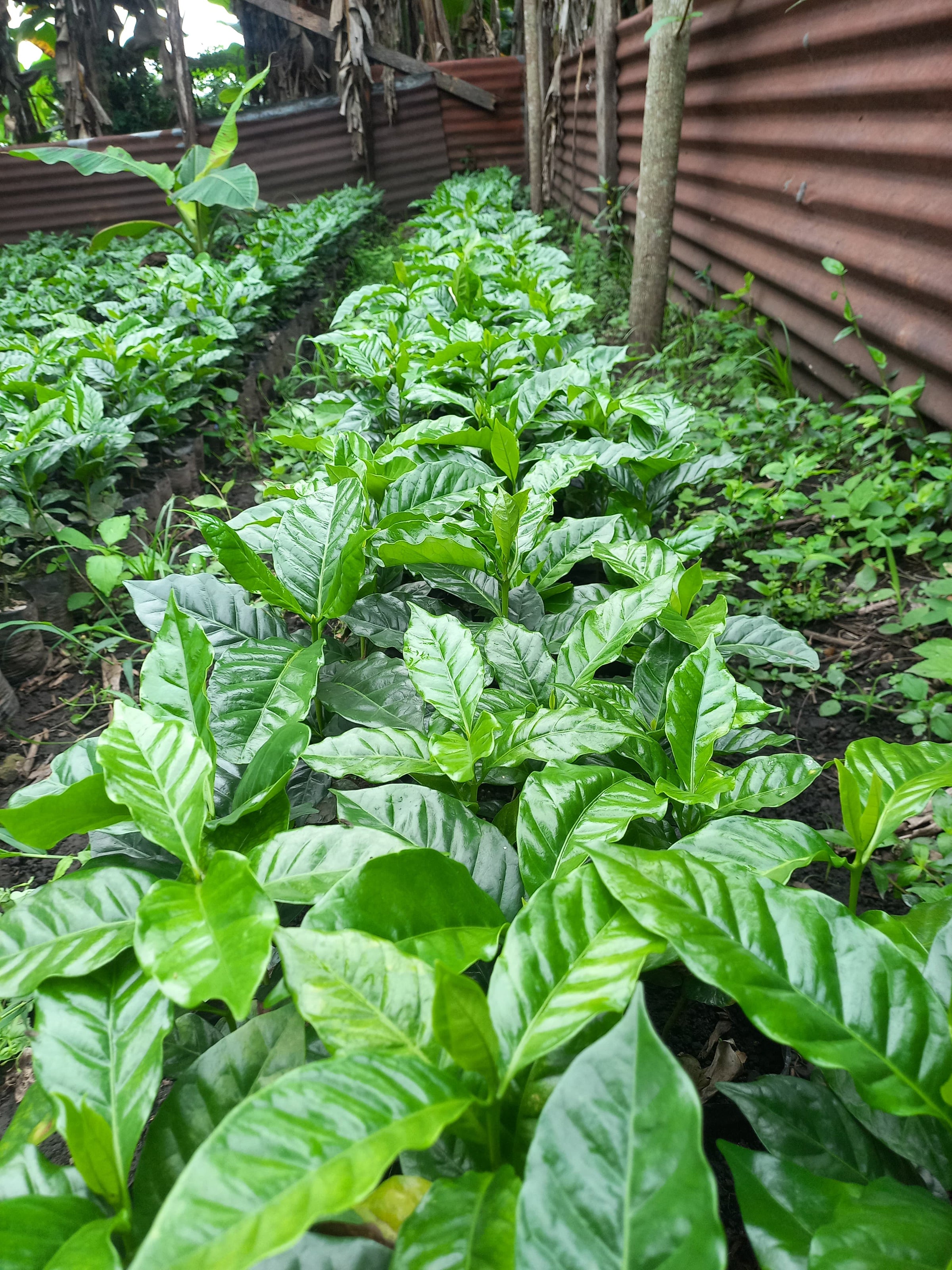
Most coffee conversations focus on flavor.
Notes of chocolate. Citrus. Floral aromas. Processing methods. Roast profiles.
But one of the most important questions facing the coffee industry today is much simpler:
How much does a coffee plant need from us to survive and thrive?
Modern coffee production has become increasingly dependent on external inputs. Across many growing regions, synthetic fertilizers, irrigation systems, and crop protection programs play an important role in maintaining productivity and supporting farmer livelihoods.
These tools have helped coffee production scale to meet global demand. Yet they also raise important questions about long-term resilience as farmers face rising input costs, climate volatility, water scarcity, and soil degradation.
What if some coffee species are naturally better equipped for these challenges?
A Different Kind of Coffee Tree
Excelsa is not Arabica.
It is not Robusta.
It is a distinct coffee species with characteristics that have attracted growing attention from researchers, farmers, and coffee professionals.
In Vietnam, where some of the world's largest populations of Excelsa trees exist, traditional cultivation often looks very different from intensive commercial coffee production.
Many Excelsa trees are grown by smallholder farmers. They are frequently integrated into mixed farming systems, rain-fed environments, and lower-input agricultural landscapes.
According to growers and agricultural specialists working directly with Excelsa production, fertilizer application is often substantially lower than what is commonly used in intensive Robusta systems. Irrigation is frequently unnecessary due to seasonal rainfall patterns. Routine pesticide programs are often limited because Excelsa demonstrates strong natural tolerance to many common coffee pests and diseases.
Importantly, these observations describe common growing patterns rather than universal practices. Farming methods vary by region, farm, and season.
The Cost of Input Dependency
Synthetic fertilizers have become a major component of modern coffee production in many parts of the world.
They can increase yields and support productivity, but they also create dependency on external inputs that are often subject to volatile pricing, supply chain disruptions, and environmental pressures.
As climate change accelerates, many coffee-growing regions are facing rising temperatures, unpredictable rainfall patterns, soil degradation, and increasing production costs.
Farmers are being asked to produce more coffee under more difficult conditions.
This raises an important question for the future of agriculture:
Can resilience become just as important as yield?
Why Excelsa Matters
Excelsa appears uniquely positioned to help answer that question.
The species is known for deep root systems, vigorous growth, adaptability to diverse environments, and strong natural hardiness.
Many traditional Excelsa trees in Vietnam are decades old. They are often rain-fed, integrated into mixed farming systems, and managed with relatively low agricultural inputs compared to intensive commercial coffee production.
In many growing regions, pesticide applications are limited or only used when unusual pest pressure occurs. Fertilizer use is often lower than in intensive coffee systems. Irrigation is frequently unnecessary because of seasonal rainfall patterns and the tree's natural adaptability.
None of this means Excelsa requires no inputs.
Agriculture is complex, and farming practices vary from farm to farm.
However, the broader pattern is noteworthy.
Excelsa has demonstrated an ability to perform in environments where lower-input management is common.
That characteristic could become increasingly valuable as the coffee industry searches for more resilient production systems.
Building Evidence, Not Claims
At Excelsa Coffee, we are careful not to make blanket claims about how all Excelsa is grown.
Agriculture is highly regional. Farming practices differ between countries, farms, and individual growers.
Instead, our focus is on building transparent supply chains that allow us to measure, verify, and improve outcomes over time.
Through our work in the Philippines, we are actively developing production systems rooted in agroforestry, biodiversity, and regenerative farming principles.
We are working directly with farmers, researchers, and agricultural partners to establish growing standards that prioritize soil health, ecosystem resilience, and long-term sustainability.
We are also actively pursuing pathways toward organic, regenerative, and Regenerative Organic Certified (ROC) standards on farms where we have direct visibility and influence.
These efforts are ongoing, and certification status varies by farm and production stage.
Our goal is not to make claims.
Our goal is to create evidence.
Looking Beyond Yield
For decades, coffee breeding and production systems focused primarily on maximizing output.
That made sense in a world where volume was the dominant concern.
The future may look different.
The next generation of coffee agriculture may need to optimize for resilience, biodiversity, water efficiency, soil health, farmer profitability, and climate adaptability alongside yield.
This is where Excelsa becomes particularly interesting.
Not because it is rare.
Not because it tastes different.
But because it may offer a glimpse into what a more resilient coffee future could look like.
Coffee's future will not be determined by flavor alone.
It will be determined by the crops, farming systems, and communities that can continue thriving in a changing world.
Excelsa is one of the species helping us explore what that future might become.