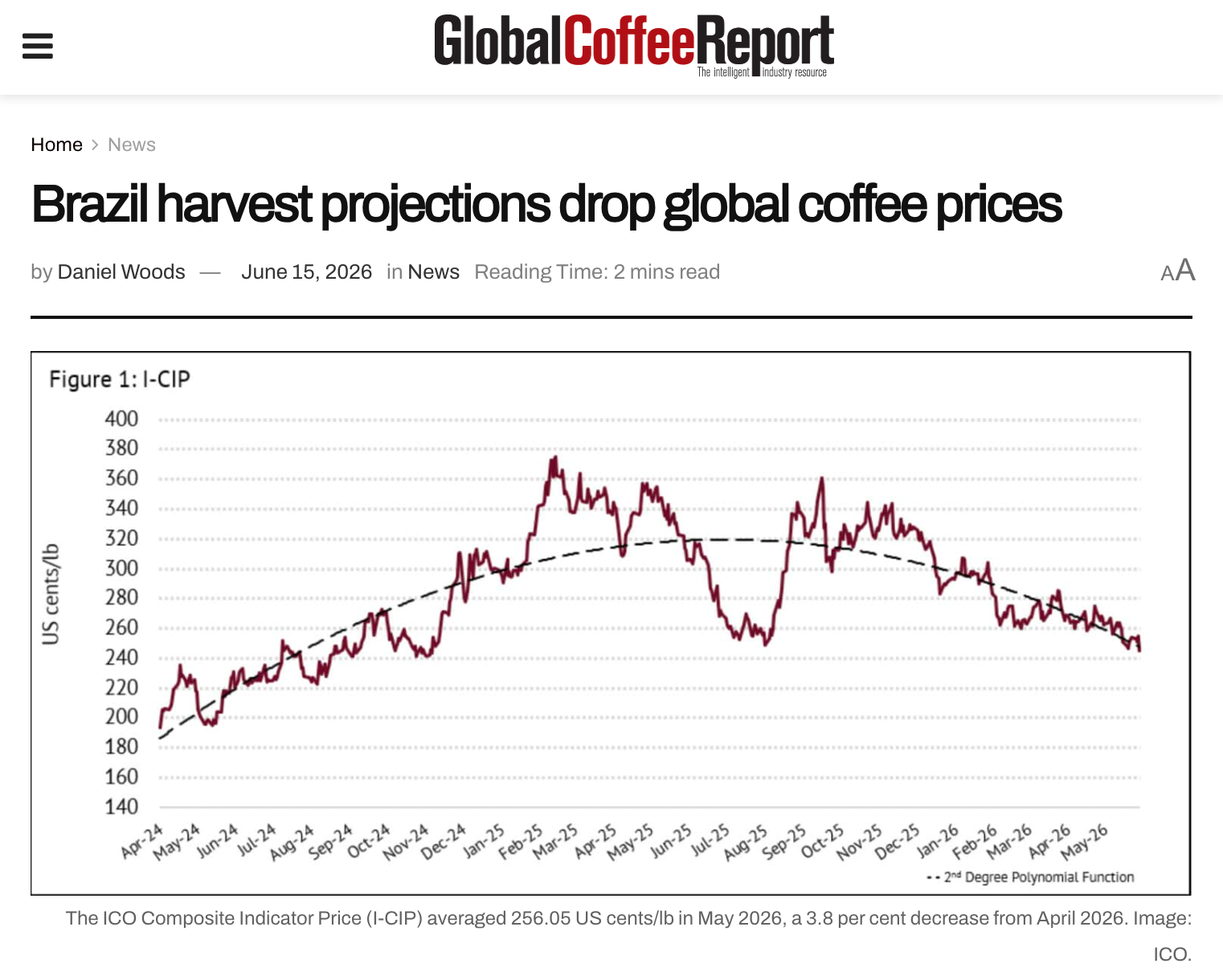
Coffee prices may be easing today, but that should not be mistaken for stability.
A near-record Brazilian crop can push Arabica prices lower in the short term. For consumers, roasters, and brands under pressure, that may feel like relief. But beneath the price movement is a deeper structural issue the coffee industry cannot afford to ignore: coffee remains dangerously dependent on a narrow genetic base, concentrated growing regions, heavy input systems, and climate-stressed farms.
The real story is not whether coffee is cheaper this month.
The real story is why prices have become so volatile in the first place.
For decades, the global coffee industry has built itself primarily around two species: Arabica and Robusta. Arabica has dominated the premium market because of its flavor and cultural status. Robusta has served much of the commodity and instant market because of its yield, caffeine, and durability. Together, they have powered the modern coffee economy.
But that same concentration has also created fragility.
When one major producing country experiences frost, drought, excessive rain, labor disruption, fertilizer cost spikes, disease pressure, or logistical strain, the entire market feels it. When Brazil produces a large crop, prices can soften. When Brazil struggles, prices can surge. That is not true resilience. That is dependence.
A healthy supply chain should not swing so dramatically on the performance of a few regions and a few dominant crop systems.
This is the uncomfortable truth behind the current price conversation: lower prices do not solve the underlying problem. They may actually obscure it.
A temporary dip can make the market feel normal again. But the structural risks remain. Farmers still face rising climate pressure. Many growing regions are still becoming hotter, drier, or less predictable. Input costs remain a major burden. Soil health remains under pressure. Chemical dependency remains high in many conventional systems. Quality remains vulnerable to weather extremes. Roasters still face uncertainty. Consumers still face future price shocks.
The coffee industry has treated volatility as a market issue. But increasingly, it is an ecological issue.
Coffee is an agricultural product before it is a beverage. It depends on trees, soil, rainfall, shade, biodiversity, labor, processing, logistics, and trust. When those systems are strained, price is simply the signal that shows up later.
That is why biodiversity matters.
At Excelsa Coffee, our focus is not just on selling a rare coffee. It is on helping build a more resilient future for coffee itself.
Excelsa is not Arabica. It is not Robusta. It is a distinct coffee species with extraordinary potential. It grows on trees. It has deep roots. It can thrive in warmer, more variable environments. It can be integrated into agroforestry and more biodiverse farming systems. It offers a different sensory profile, a different agricultural story, and a different path forward for an industry that has relied too heavily on too few answers.
That does not mean Excelsa is a magic solution. No crop is.
But it does mean the industry needs more genetic diversity, more farming models, more sourcing options, and more resilient supply chains.
The future of coffee cannot simply be more Arabica planted in increasingly stressed environments with more chemical inputs to hold the system together. That model is expensive, vulnerable, and ultimately unstable.
The future has to include broader species diversity. It has to include crops that can reduce pressure on farmers. It has to include farming systems that work with ecology rather than constantly fighting against it. It has to include quality, affordability, and resilience at the same time.
That is the opportunity Excelsa represents.
For roasters and coffee brands, this is not just a sustainability story. It is a margin and supply-chain story. When prices swing wildly, businesses struggle to plan. When quality becomes inconsistent, brands lose trust. When sourcing becomes more expensive, consumers eventually feel it. When farming systems become too input-dependent, everyone in the chain inherits that risk.
Excelsa offers a practical hedge.
Not as a replacement for Arabica or Robusta, but as a necessary expansion of the coffee portfolio.
A more resilient coffee future will not come from betting everything on one species, one origin, or one production model. It will come from building a diversified system where farmers have more options, roasters have more flexibility, and consumers have access to coffees that are both meaningful and durable.
That is where the industry needs to move.
The current price dip may feel like good news. In the short term, it is. But the larger lesson is not that coffee is safe. The lesson is that coffee remains exposed.
At Excelsa Coffee, we are building toward a different kind of stability.
Stability through biodiversity.
Stability through resilient genetics.
Stability through better farming systems.
Stability through supply chains that are not overly dependent on monoculture thinking.
Coffee’s future will not be secured by producing more of the same.
It will be secured by expanding what coffee can be.